The Semantic Web of Chat: How LLMs are Interpreting Custom Emotes to Curate Real-Time Stream Highlights (2026)
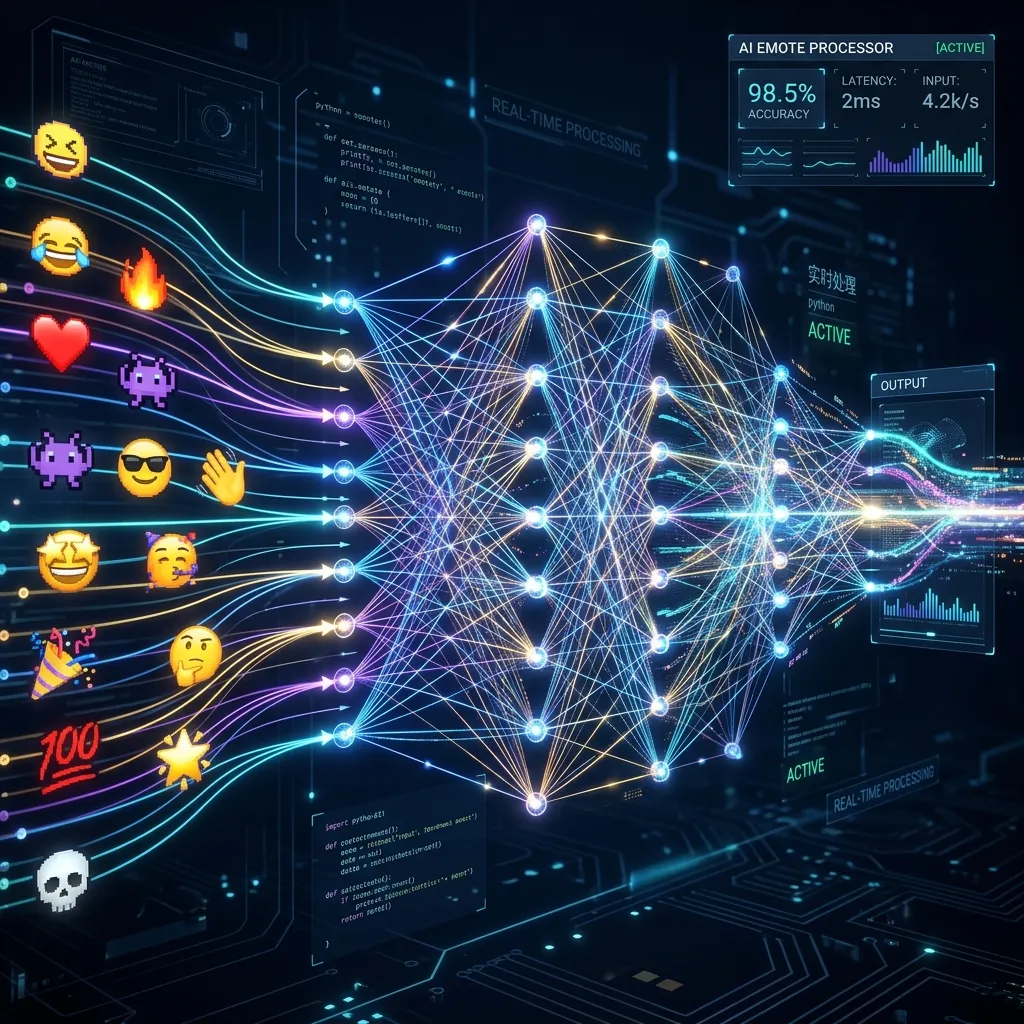
For the past decade, the live streaming industry has faced an insurmountable big data problem: how do you meaningfully analyze a chat interface that moves at 2,000 messages per second? Historically, moderation bots and sentiment analyzers relied on rigid keyword matching and basic statistical clustering. However, as we progress into late 2026, the paradigm is shifting radically. We are no longer just counting the frequency of a custom emote; we are leveraging specialized Large Language Models (LLMs) to understand the contextual, semantic weight of that emote within the rapidly evolving dialect of an individual community.
Our Data Science division has spent the last year implementing bespoke transformer architectures directly into the ingest pipelines of top-tier streaming organizations. What we have discovered is that custom emotes are not just digital stickers—they are highly dense semantic tokens. When properly tokenized and ingested by an LLM with sub-100 millisecond latency, these visual tokens unlock a level of automated curation, algorithmic discoverability, and real-time audience feedback that was previously considered science fiction.
The Failure of Traditional Sentiment Analysis in Live Chat
To understand the breakthrough, we must first address why legacy sentiment analysis algorithms consistently failed in live stream environments. Traditional Natural Language Processing (NLP) models, trained on Wikipedia articles, corporate emails, or even Twitter datasets, fundamentally misunderstood Twitch and Kick chat cultures.
The Irony Barrier and Contextual Drift
If a streamer fails spectacularly at a video game, the chat might flood with "LUL" or a custom crying-laughing emote. A legacy sentiment analyzer, seeing laughter, categorizes the moment as "joyous" or "positive." However, the contextual reality is that the streamer is frustrated, and the chat is expressing schadenfreude. Furthermore, "Contextual Drift" occurs rapidly. An emote that meant "hype" on Tuesday might become a sarcastic symbol for "disappointment" by Thursday, based on an inside joke that occurred off-stream on Discord.
Legacy systems lacked the contextual memory and the temporal awareness to track the semantic migration of an emote's meaning. They were static dictionaries attempting to translate a fluid, highly iterative tribal language.
Tokenizing the Visual: Emotes as Linguistic Artifacts
The breakthrough in 2026 relies on treating custom emotes identically to complex vocabulary words within a localized language model. When a viewer types :customHype:, the system does not merely render the 28x28 pixel image. Behind the scenes, the chat ingest server tokenizes this emote. The true innovation lies in the embeddings.
Dynamic Emote Embeddings
In modern stream-analysis architectures, each custom emote is assigned a dynamic vector embedding. Unlike standard word embeddings (like Word2Vec or GloVe) which remain relatively static after training, these "Emote Vectors" are continuously updated in real-time. If the community suddenly begins using the :customHype: emote ironically during moments of failure, the LLM observes this new co-occurrence pattern (e.g., the emote being heavily clustered around negative gameplay events and words like "throw" or "choke"). The vector space of that emote shifts algorithmically within minutes.
- High-Dimensional Semantic Mapping: Emotes are mapped across hundreds of dimensions, capturing nuances like "Sarcasm vs. Genuine Praise," "Anticipation vs. Reaction," and "Inside Joke vs. General Broadcast."
- Cross-Modal Inference: The LLM correlates the visual token (the emote) with the audio sentiment of the streamer. If the streamer is screaming in frustration, and the chat is spamming a specific custom emote, the model learns the exact flavor of that interaction.
The Sub-Millisecond Architecture of Real-Time Curation
Processing text is computationally inexpensive. Processing 2,000 distinct semantic tokens per second, cross-referencing them against a dynamic vector database, and updating the streamer's dashboard in real-time requires a highly specialized, edge-computed infrastructure.
The Role of Small Language Models (SLMs)
We are not sending chat logs to massive, generalized models like GPT-5 or Claude. The latency and cost would be catastrophic. Instead, the industry standard has shifted to hyper-specialized Small Language Models (SLMs) deployed directly on edge servers geographically adjacent to the ingest nodes. These SLMs, typically ranging from 3 to 7 billion parameters, are fine-tuned specifically on streaming vernacular and the streamer's historical VOD (Video on Demand) transcripts.
The Algorithmic Curation Pipeline
Here is how a state-of-the-art 2026 real-time curation system operates during a live broadcast:
- Ingestion and Tokenization: The chat socket feeds directly into a lightweight preprocessing node. Text and emotes are converted into unified semantic tokens.
- Temporal Windowing: The SLM analyzes rolling 5-second windows of chat, comparing the semantic density of the current window against the baseline average of the past 20 minutes.
- Semantic Spike Detection: When a significant deviation occurs (e.g., a massive influx of "confusion" or "hype" vectors), the system flags the timestamp.
- Contextual Summarization: The SLM immediately reviews the preceding 30 seconds of the streamer's audio transcript and the specific emotes used. It generates a micro-summary: "Streamer discovered a hidden boss; chat reacted with high anticipation and surprise emotes."
- Automated Highlight Generation: If the semantic score breaches the "Viral Threshold," the VOD pipeline automatically clips the segment, tags it with the SLM's summary, and pushes it to an editorial queue for platforms like TikTok or YouTube Shorts.
The Deep Psychology of Emote-Driven Discoverability
This technological leap fundamentally alters how platforms handle discoverability. For years, the recommendation algorithm relied on passive metrics: Click-Through Rate (CTR) and Average View Duration (AVD). While still important, these metrics are trailing indicators. They tell you someone stayed, but they don't tell you why they stayed or how they felt.
By interpreting the semantic web of emotes, platforms can now categorize streams based on real-time emotional states.
The "Vibe" Routing Algorithm
Imagine a viewer opening a streaming platform on a Friday evening. The platform knows, based on historical biometric and engagement data, that this specific user currently responds best to "High-Tension, High-Skill Gameplay with Sarcastic Community Commentary."
The platform's routing algorithm interrogates the real-time LLM outputs of thousands of live channels. It finds a streamer whose current chat semantic vector perfectly matches this description—perhaps a Speedrunner attempting a world record, whose chat is heavily utilizing tension-based and sarcastic custom emotes. The viewer is routed directly to this stream, not based on the game being played, but based on the precise emotional state of the community at that exact millisecond.
Redefining Creator IP: Emotes as Machine Learning Data
As this technology matures, it introduces a profound shift in the valuation of creator IP. Custom emotes are no longer just monetization perks for subscribers; they are the high-quality, proprietary training data that fuels the streamer's discoverability engine.
The Superiority of High-Fidelity Custom Assets
Our research indicates that channels utilizing a highly diverse, culturally specific set of custom emotes generate significantly more accurate semantic maps than channels relying on global platform emotes. A global emote like "Kappa" is semantically noisy; it means a million different things across a million different channels. A custom emote designed exclusively for a specific community inside joke is semantically pure.
When the SLM detects a spike in a semantically pure custom emote, the confidence interval of its highlight generation skyrockets. Therefore, investing in professional, highly specific custom emote design directly translates into algorithmic favorability. The algorithm promotes what it can understand, and it understands distinct, localized visual vocabularies far better than generic ones.
The Future: Interactive Semantic Feedback Loops
Looking ahead to 2027, the integration of LLMs and custom emotes will move from passive analysis to active, automated stream modification. We are currently testing systems where the semantic output of the chat directly interfaces with the game engine itself.
If the LLM detects a high concentration of "boredom" or "distraction" emote vectors over a 10-minute period, it can trigger an API call to the game being played, seamlessly increasing the difficulty, spawning an unexpected event, or altering the lighting to recapture audience attention. This creates a closed semantic feedback loop: the audience feels an emotion, expresses it via a visual token, the AI understands the nuance of that token, and the digital environment reacts autonomously to stimulate a new emotion.
Conclusion: The Necessity of Professional Asset Management
The streaming landscape is transitioning from an era of broadcast to an era of continuous, multi-modal semantic interpretation. The creators who will dominate the next half-decade are those who understand that their chat interface is the most sophisticated feedback mechanism ever devised.
To leverage this technology, creators must cultivate their visual vocabulary with extreme intentionality. Emotes must be distinct, highly readable at 28x28 pixels to encourage rapid deployment, and strategically designed to capture a wide spectrum of complex emotions. The AI is watching, reading, and interpreting every single pixel your community deploys. It is imperative that you give them the best possible vocabulary to speak with.

Levi
Chief Editor & Hardware Analyst
A veteran PC builder and open-world enthusiast, Levi specializes in hardware benchmarking and engine analysis. He also contributes to Specvi.com and LeonidaInsider.com.
Ready to Resize Your Emotes?
Use our free tool to create perfectly sized emotes for Twitch, Kick, and Discord. No watermarks, no uploads—your images never leave your device.
Try the Emote Resizer →Related Articles
Complete Twitch Emote Size Guide for 2026: Everything Streamers Need to Know
Master Twitch emote requirements with our comprehensive 2026 guide. Learn exact pixel dimensions (28x28, 56x56, 112x112), file formats, optimization tips, and common mistakes to avoid.
How to Create Animated Twitch Emotes: The Complete 2026 Guide
Learn to create smooth, engaging animated Twitch emotes that meet all requirements. Covers GIF optimization, frame rates, file size tricks, and recommended software.